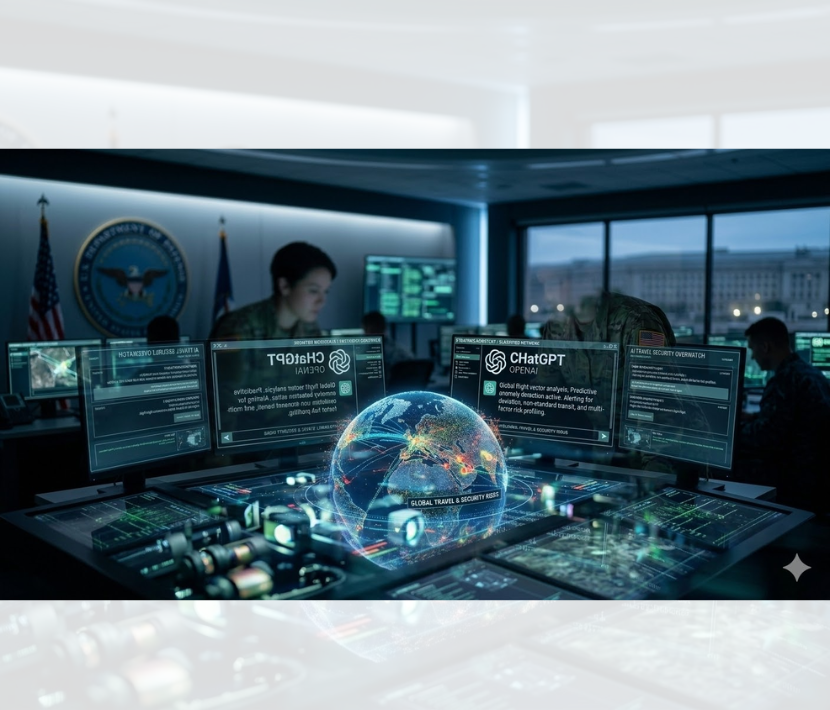
AI in Military and Its Impact on International Travel Safety
- • AI technologies used in national security are influencing travel safety
- • Airports use AI for surveillance and threat detection
- • Border control systems are becoming smarter with AI
- • Future travel will rely more on AI-powered security systems
How does AI used in military technology affect travel security?
AI military technology impact on travel– Artificial intelligence used in military and government security systems is also improving airport safety, border control, and threat detection. Technologies developed for national defense are increasingly being adapted for civilian travel security, helping airports analyze risks faster and enhance traveler safety.
Artificial intelligence is becoming a critical tool in global security systems. Recent developments involving AI technology used by government and defense organizations highlight how advanced AI models can analyze data, detect threats, and support decision-making. These innovations are also influencing travel security by improving airport screening, border monitoring, and traveler safety systems worldwide.
How is AI improving travel security?
AI improves travel security by analyzing large amounts of data to detect potential threats, monitor airport environments, and enhance border control systems. Governments and security agencies increasingly rely on AI-powered tools to improve traveler safety and speed up security processes.
Here’s a surprising fact: AI security systems now analyze thousands of traveler data points in under a second — before you ever reach a checkpoint. That is the power of AI military technology and its impact on travel safety today.
If you travel internationally, this affects you directly. The systems scanning your passport, reading your face at the border, and flagging unusual luggage patterns are no longer operated by humans alone. Artificial intelligence defense technology, once built exclusively for the battlefield, is now embedded in airports, border crossings, and global security networks around the world.
This guide from Travel The World Today walks you through exactly how this works — and what it means for your safety, your privacy, and your next trip abroad. Whether you are a frequent flyer or planning your first international adventure, understanding AI in the military and its impact on international travel safety helps you travel smarter and more confidently.
What Is AI Military Technology and Why Does It Matter for Travelers?
AI military technology refers to artificial intelligence systems originally designed for national defense. These include threat detection algorithms, autonomous surveillance drones, predictive analytics systems, and machine learning models built to identify risks in real time.
Governments and defense agencies developed these tools for combat zones and intelligence operations. Over the past decade, however, many of these systems have migrated into civilian infrastructure — especially international travel hubs.
Why does this matter to you as a traveler?
Because the security systems you interact with at airports and borders are increasingly powered by the same AI used in military operations. The AI defense technology impact on your journey is real, measurable, and growing every year.
Here is what these systems were originally built to do:
- Identify threats in complex, high-noise environments
- Analyze patterns across enormous data sets
- Flag anomalies faster than any human operator
- Integrate information from multiple surveillance sources simultaneously
These capabilities now protect the airports, border crossings, and transit hubs you use every time you travel internationally.
How AI in Military Has Transformed Airport Security
Airports are among the most complex security environments in the world. Millions of people pass through them daily. AI in airport security has fundamentally changed how that challenge is managed.
Traditional security relied heavily on human observation, manual document checks, and physical screening. These methods were slow, inconsistent, and prone to human error. Artificial intelligence security systems replaced or augmented many of these steps with faster, more accurate technology.
AI Threat Detection at Checkpoints
AI threat detection systems at airport checkpoints can now scan carry-on bags and identify prohibited items more accurately than older X-ray technology. These systems are trained on millions of images of dangerous objects. They learn to recognize threats even when items are hidden, stacked, or disguised.
The TSA in the United States has deployed AI-enhanced computed tomography (CT) scanners at major airports. These machines create a 3D image of your bag and automatically flag suspicious content. You may have noticed the process is faster at some airports — that is AI at work.
Beyond baggage, AI threat detection also monitors behavioral patterns. Cameras connected to AI systems track movement, eye contact, stress indicators, and unusual behavior across terminal spaces. Security staff receive real-time alerts when the system identifies someone who may require additional screening.
Smart Airport Technology in Action
Smart airport technology extends well beyond the security checkpoint. Consider what happens from the moment you arrive at a major international airport today:
- Facial recognition cameras match your face to passport data
- AI-powered crowd analytics detect unusual gatherings or blocked exits
- Automated screening lanes guide you through security based on risk profiling
- License plate recognition monitors airport roads and parking areas
- Real-time threat mapping overlays all of this data into a unified security picture
Airports like Hartsfield-Jackson Atlanta, Dubai International, and Singapore Changi are global leaders in deploying this kind of smart airport technology. The U.S. Customs and Border Protection agency has expanded AI airport security tools at dozens of international entry points across the country.
AI Border Control Systems — What Happens When You Cross a Border Today
When you land in another country and approach passport control, you are entering one of the most AI-intensive zones in international travel. AI border control systems are now standard at major entry points across North America, Europe, Asia, and the Middle East.
These systems were developed from military-grade intelligence tools adapted for civilian use. Their job is simple: confirm your identity, assess your risk level, and decide whether to let you through — in seconds.
Biometric Screening and Facial Recognition
Biometric screening is the most visible form of AI at border control. Your face, fingerprints, and sometimes iris patterns are captured and compared against government databases in real time.
In the United States, CBP’s Biometric Entry-Exit Program uses facial recognition AI at over 200 airports. When you approach a boarding gate or arrive at a port of entry, a camera captures your image. The AI cross-references it against your passport photo, visa records, and watchlists — all in under two seconds.
This technology comes directly from AI government security programs. The underlying facial recognition models were first developed for military applications in conflict zones where identifying individuals quickly was a matter of life and death.
For you as a traveler, this means:
- Faster processing at border control
- More accurate identity verification
- Reduced risk of identity fraud or stolen passport use
- A higher chance of catching individuals flagged on security watchlists
AI-Powered Document Verification
Beyond facial recognition, AI border control systems also verify your travel documents with far greater precision than human inspectors. Machine learning models scan for micro-details on passports and visas — things invisible to the naked eye — that indicate forgery or tampering.
The Department of Homeland Security uses AI document verification tools that cross-reference hundreds of data points on a single passport in real time. These systems were developed in partnership with national security technology programs and have since become standard at U.S. ports of entry.
The OpenAI Military Partnership and What It Means for Travel
In early 2024, OpenAI revised its usage policies to allow partnerships with military and defense organizations for specific applications. This OpenAI military partnership marked a significant shift in how advanced AI language models and analytical tools could be deployed in national security contexts.
You may wonder: what does ChatGPT military use have to do with your flight to Paris?
More than you might think.
Large language models and advanced AI tools developed for or used in defense contexts have downstream effects on the broader AI ecosystem. When defense agencies invest in AI research — as they have done for decades — those technologies eventually diffuse into civilian systems.
The OpenAI military partnership opened the door for AI tools to assist with:
- Threat intelligence analysis across vast data sets
- Multilingual translation and communication in border security contexts
- Identifying disinformation that could affect travel advisories
- Predictive modeling for security risk assessment at international events
While ChatGPT’s military use does not mean a chatbot is reviewing your visa application, it does reflect how deeply AI is becoming integrated into the national security technology stack, which directly shapes the infrastructure you travel through.
How AI Defense Technology Protects International Travelers
The clearest way to understand the AI defense technology’s impact on your travel experience is to look at where these systems are actively operating today.
Border Surveillance AI
Border surveillance AI uses drone technology, satellite imagery analysis, and ground sensor networks originally developed for military use. These systems monitor border regions continuously, flagging unusual movement patterns and potential smuggling or trafficking activity.
In the United States, Customs and Border Protection deploys AI-enhanced surveillance towers along the southern border. These towers use sensors and AI algorithms to distinguish between humans, animals, and vehicles — and to assess threat levels without requiring a human operator on-site for every alert.
For you as an international traveler, border surveillance AI makes the zones around legal entry points significantly safer. Criminal activity, trafficking networks, and unauthorized crossings are more effectively detected and intercepted before they reach the same terminals you use.
AI Global Security Systems in Use Today
AI global security systems operate at a level above individual airports and borders. These are interconnected networks of threat intelligence, shared between allied governments and security agencies.
The Five Eyes intelligence alliance — comprising the United States, United Kingdom, Canada, Australia, and New Zealand — shares AI-analyzed security data in real time. This means that a threat identified in London can be flagged in New York within minutes.
Interpol’s I-24/7 network connects over 190 countries and uses AI to analyze and distribute security alerts. When you travel internationally, the security agencies at both ends of your journey are working within these shared AI global security systems.
Travel Safety Innovations You Benefit From Right Now
Here is a clear breakdown of the key travel safety innovations currently deployed at major international travel hubs, how they work, and their direct benefit to you:
| Technology | Origin | Where It’s Used | Benefit to Traveler |
|---|---|---|---|
| Facial Recognition AI | Military intelligence | Airports, border control | Faster identity verification |
| CT Bag Scanners + AI | Defense imaging tech | Airport checkpoints | More accurate threat detection |
| Behavioral Analytics AI | Military surveillance | Airport terminals | Early identification of suspicious behavior |
| Biometric E-Gates | Government security programs | International arrivals | Reduced wait times, higher accuracy |
| AI Document Verification | DHS / national security | Ports of entry | Forgery detection in real time |
| Border Surveillance Drones | Military drone programs | Land and sea borders | Safer legal entry zones |
| AI Watchlist Screening | Intelligence community | Airlines, border control | Prevents known threats from boarding |
| Predictive Risk Scoring | Defense analytics | Pre-travel screening | Risk-based security, less hassle for low-risk travelers |
Each of these traveler safety technologies either originated in military programs or was significantly accelerated by defense investment. They represent the most direct expression of AI military technology’s impact on travel safety.
How To Stay Safe as an International Traveler in the AI Era
Here is your practical, step-by-step guide to navigating international travel in a world shaped by AI military technology and its impact on travel security.
Step 1: Enroll in Trusted Traveler Programs
The U.S. government offers programs like TSA PreCheck, Global Entry, and NEXUS that integrate your biometric data into AI screening systems. Once enrolled, you are pre-vetted. The AI systems at checkpoints recognize you as a low-risk traveler, which means:
- Faster processing at security
- Shorter lines at border control
- Less invasive screening overall
Enrollment takes about 10 minutes online and an in-person appointment. It is one of the most effective steps you can take to benefit from AI travel security technology rather than be slowed by it.
Step 2: Keep Your Travel Documents Updated and Clean
AI-powered document verification systems are highly sensitive. Damaged, worn, or out-of-date travel documents cause delays and flags in the system.
- Renew your passport if it expires within 6 months of travel
- Keep your passport pages free of tears, water damage, or unauthorized stamps
- Ensure your visa information is accurate and matches your profile in government databases
An AI system flagging your document does not mean you are a suspect — but it will slow your journey significantly.
Step 3: Understand Biometric Consent and Opt-Out Rights
In the United States, U.S. citizens have the right to opt out of facial recognition screening at airports. Not all travelers know this.
If you prefer not to have your biometric data captured:
- Inform the CBP officer or airline staff at the gate before scanning
- Request a manual identity verification process
- Be prepared for a slightly longer processing time
This is your right under current U.S. policy. AI in government security operates within legal frameworks, and knowing your rights is part of traveling smart.
Step 4: Register with the STEP Program Before International Travel
The Smart Traveler Enrollment Program (STEP) from the U.S. State Department allows you to register your travel plans. In a security emergency or natural disaster, authorities can locate and assist you faster — partly because AI systems cross-reference STEP data with on-the-ground intelligence.
- Visit travel.state.gov to register
- Update your registration for every international trip
- Enable alerts for the countries you are visiting
Step 5: Stay Aware of AI-Driven Travel Advisories
The U.S. State Department and Department of Homeland Security now use AI analytics to generate and update travel advisories. These systems analyze real-time threat data, social media signals, regional conflict patterns, and historical incident data.
Check travel advisories before every international trip:
- State Department: travel.state.gov
- DHS travel alerts
- Your airline’s security briefings
When advisories are updated quickly — sometimes within hours of an incident — that speed is often the result of AI threat detection working in the background.
Step 6: Be Cooperative and Prepared at AI-Enhanced Checkpoints
Knowing what to expect makes every checkpoint faster and less stressful. Here is what to do:
- Remove electronics and liquids before reaching the conveyor
- Look directly at the camera at the facial recognition stations
- Have your passport open to the photo page at the biometric gates
- Follow lane instructions from automated screening systems
- Do not photograph security equipment — this can trigger alerts
- Respond honestly if flagged for additional screening — delays from AI flags are almost always procedural, not personal
Concerns About AI in Government Security and Traveler Privacy
Honest coverage of this topic requires acknowledging the concerns. AI in government security raises legitimate questions about privacy, data use, and civil liberties.
Key concerns raised by privacy advocates and civil rights organizations include:
- Facial recognition bias — Studies have shown that some AI facial recognition systems perform less accurately on darker skin tones and women, which can lead to disproportionate screening burdens
- Data retention — How long is your biometric data stored, and who has access to it?
- False positives — An AI system flagging you incorrectly can cause significant delay and distress
- Scope creep — Technologies deployed for security can be repurposed for broader surveillance
Organizations like the ACLU and Electronic Frontier Foundation have published extensive research on these risks. As a traveler, you deserve to be informed about both the benefits and the limitations of these systems.
The future of AI in travel safety depends on governments, technology developers, and civil society working together to ensure these tools remain proportionate, transparent, and subject to meaningful oversight.
The Future of AI in Travel Safety
The future of AI in travel safety is moving fast. Here is what is already in development or early deployment at international travel hubs:
1. Predictive Threat Scoring AI systems will move beyond reactive screening to predictive models that assess risk before a traveler even arrives at the airport, drawing on booking patterns, travel history, and intelligence data.
2. Autonomous Security Robots Several major airports in Asia and the Middle East are piloting AI-powered robots that patrol terminals, detect unattended bags, and assist passengers — all using military-derived autonomous navigation technology.
3. AI-Powered Health and Bio-Security Screening. After COVID-19, biosecurity has become part of travel safety innovations. AI systems that can detect signs of illness through thermal imaging or behavioral patterns are being refined for airport deployment.
4. Seamless, Tokenized Identity The concept of a digital travel token — a secure, AI-verified digital identity that replaces your physical passport at every checkpoint — is being actively developed by the International Air Transport Association (IATA) and several governments.
5. Real-Time Multilingual Threat Communication Building on tools like large language models, security agencies are developing AI systems that can communicate threat intelligence across language barriers in real time — making AI global security systems more effective in multinational environments.
Frequently Asked Questions
Q: Does AI facial recognition at airports apply to all travelers, including U.S. citizens?
A: Facial recognition is used at many U.S. airports for international departures and arrivals. U.S. citizens can opt out by informing staff and requesting manual processing. Non-citizens do not have the same opt-out right under current CBP policy.
Q: Is the AI used in airport security the same as what the military uses?
A: Not the same systems, but many civilian airport AI tools are derived from or inspired by military-grade technology. Defense investment in AI has historically accelerated civilian applications, particularly in threat detection, surveillance, and biometrics.
Q: How does AI border control affect my travel time?
A: For most travelers, AI border control significantly reduces processing time. Biometric e-gates at major airports can process a traveler in under 15 seconds. The main delays occur when AI systems flag anomalies, which trigger human review.
Q: What is the OpenAI military partnership, and should travelers be concerned?
A: OpenAI updated its policies in 2024 to permit certain defense applications. This does not mean AI chatbots are making border control decisions. It reflects a broader trend of advanced AI tools being integrated into national security technology ecosystems, which indirectly shapes the infrastructure that all international travelers pass through.
Q: What can I do if I am wrongly flagged by an AI security system at a border?
A: Stay calm and cooperative. Ask to speak with a supervising officer. If you are a U.S. citizen flagged incorrectly, you can file a complaint through DHS TRIP (Traveler Redress Inquiry Program) at dhs.gov/trip. Document the incident, including time, location, and the reason given for the flag.
Q: Are AI border control systems accurate enough to be trusted?
A: Current AI biometric systems achieve accuracy rates above 99% in controlled conditions. However, environmental factors, document quality, and demographic variables can affect performance. Human oversight remains a critical part of every AI-enhanced security process.
Key Takeaways
“AI military technology is no longer confined to the battlefield. It is in every airport, every border crossing, and every security system you interact with as an international traveler — and understanding it makes you safer.” — Travel The World Today
- AI in airport security uses military-derived technology to detect threats faster and more accurately than human screeners alone
- AI border control systems combine facial recognition, document verification, and risk scoring to process travelers in seconds
- The OpenAI military partnership reflects a broader integration of advanced AI into national security technology
- Travel safety innovations like biometric e-gates and CT scanners with AI are direct benefits of defense technology investment
- You have rights when it comes to AI in government security — including the right to opt out of facial recognition as a U.S. citizen
- Enrolling in TSA PreCheck or Global Entry helps you benefit from AI screening rather than be delayed by it
- The future of AI in travel safety includes predictive threat scoring, digital travel tokens, and autonomous security systems
Conclusion: Travel Smarter in the Age of AI Security
AI military technology and its impact on travel safety is one of the most important stories in modern international travel — and most travelers never think about it until they are standing in a security line, wondering why the process feels different than it used to.
Now you know why.
The same artificial intelligence that was developed to protect soldiers and secure national borders is working quietly behind the scenes every time you fly internationally. It is scanning your bag, confirming your identity, cross-referencing global watchlists, and monitoring the terminals around you — all in real time, all in the background.
That is a remarkable technological achievement. It also comes with responsibilities — to build these systems fairly, to protect traveler privacy, and to ensure that the power of AI defense technology serves all travelers equitably.
At Travel The World Today, we believe the best traveler is an informed traveler. Understanding the technology that protects you — and knowing your rights within it — is part of traveling well.
Ready to Travel With Confidence?
Explore more expert travel safety guides at Travel The World Today. From pre-trip checklists to destination security briefings, we guide you at every stage of your journey.
Enroll in Global Entry today and experience how AI travel security technology can work for you, not against you. Subscribe to our newsletter for weekly travel safety updates, destination guides, and the latest on travel technology that affects your journey.
Travel smarter. Travel safer. Travel The World Today.

Hi, I am Raghav Ahuja a curious explorer, travel enthusiast, and the voice behind Travel The World Today. I believe in discovering the beauty of every destination without breaking the bank. Through my journeys, I share tips, stories, and travel guides to help you explore the world on a budget. Whether you’re a solo adventurer, a family traveler, or just planning your next escape, I’m here to inspire and guide you every step of the way.

Post Comment